Throughout the thesis
Use AI in your thesis and be able to account for it
Your university, your ethics approval, your supervisor and every journal you submit to may each have a rule about AI tools. This kit keeps one record that satisfies all of them.
The risk for a candidate is rarely the use itself. It is being asked at submission, in the viva or by an editor what you used, on which data and how you checked it - and having no record.
What you work through
- List what you already useAn honest inventory of every use so far, with the risk attached to each.
- Collect the rules that bind youUniversity, graduate school, supervisor, ethics approval, funder and target journals - quoted and dated.
- Decide task by taskTen common thesis tasks with where the line usually falls, and your decision for each.
- Set a data gateWhat may never be pasted into a tool - participant data first - decided before a deadline.
- Prompt so the output can be checkedPrompt structure, guardrail phrases and a log of outputs you kept.
- Check references and citationsWhy invented references happen, the signs, and the check that catches them.
- Check code and analysis helpThe tests between generated code and a wrong result in your thesis.
- Draw the line in writing supportWhere editing becomes generating, and what to re-read after any change.
- Verify everything you keepOne verification routine by output type, with the evidence to keep on file.
- Write the disclosureA statement skeleton, a threshold test and where it goes in a thesis or paper.
- Audit yourselfAn oversight log, the ethics questions and a bias check.
- Set your own standing policyDecide once, calmly, what you will allow yourself in the rest of the doctorate.
The Logs & Disclosure workbook
The workbook that goes with the worksheets, for Excel or Google Sheets:
- Policy Register — each rule that applies to you, quoted, with a date to re-check
- Data Gate — what may and may not go into a tool, and who decided
- Use Log — each use behind material you kept, and how you reviewed it
- Verification — what you checked and against what, flagging anything unverified
- Disclosure — your statement, where it appears, and whether it covers every use
Look inside
Low-resolution, watermarked previews of four pages.
Is it for you?
- Candidates who already use AI tools for reading, coding or language support and want that use on the record.
- Anyone facing an AI declaration on a thesis submission form, an ethics amendment or a manuscript.
It does not tell you what your university allows - your institution does. It names no tools and takes no position on any vendor.
Free to use alongside it: Guide: getting research ethics approval.
The AI Use & Disclosure Kit — $9, one-time.
Kits for your other milestones
-
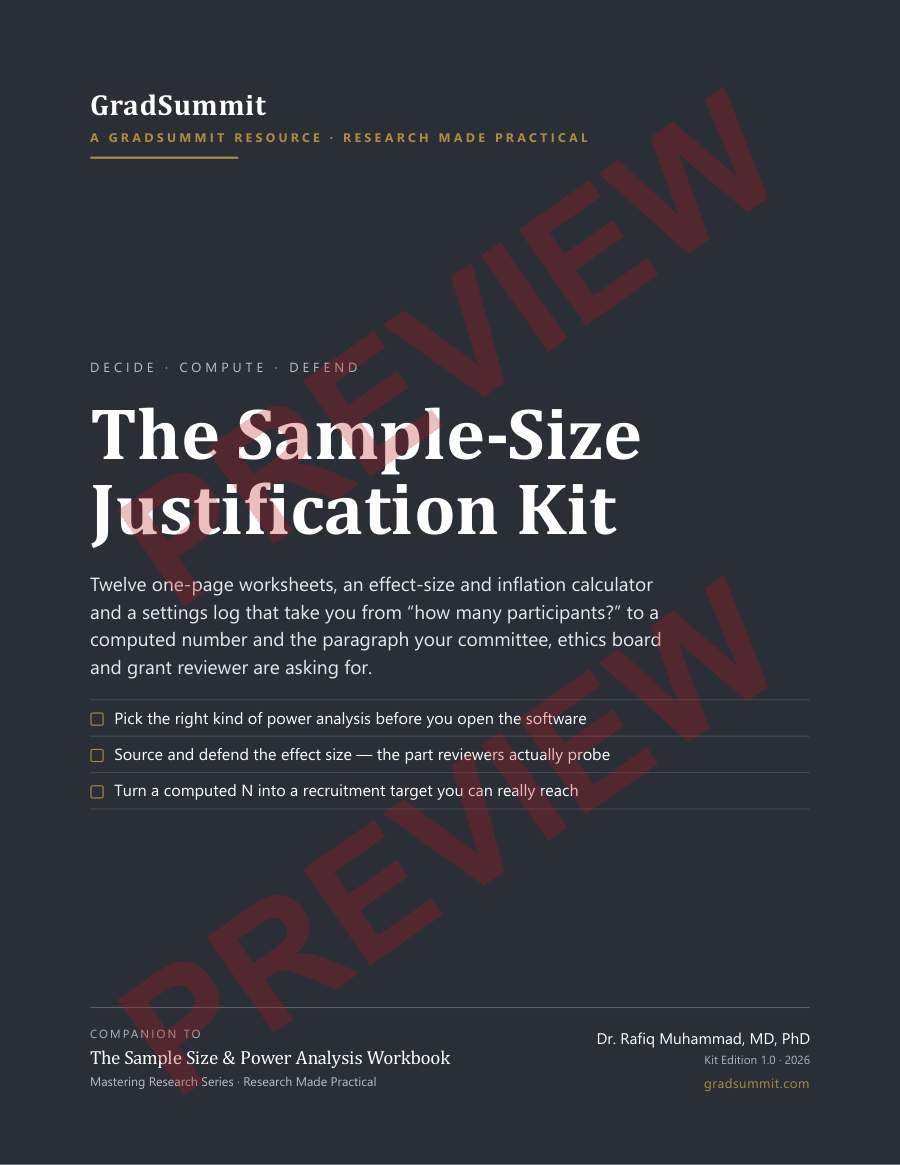 Proposal, ethics and confirmation
The Sample-Size Justification Kit
Worksheets and a calculator log for the sample-size section your committee and ethics board will question: a sourced effect size, a number and the paragraph.
$12 -
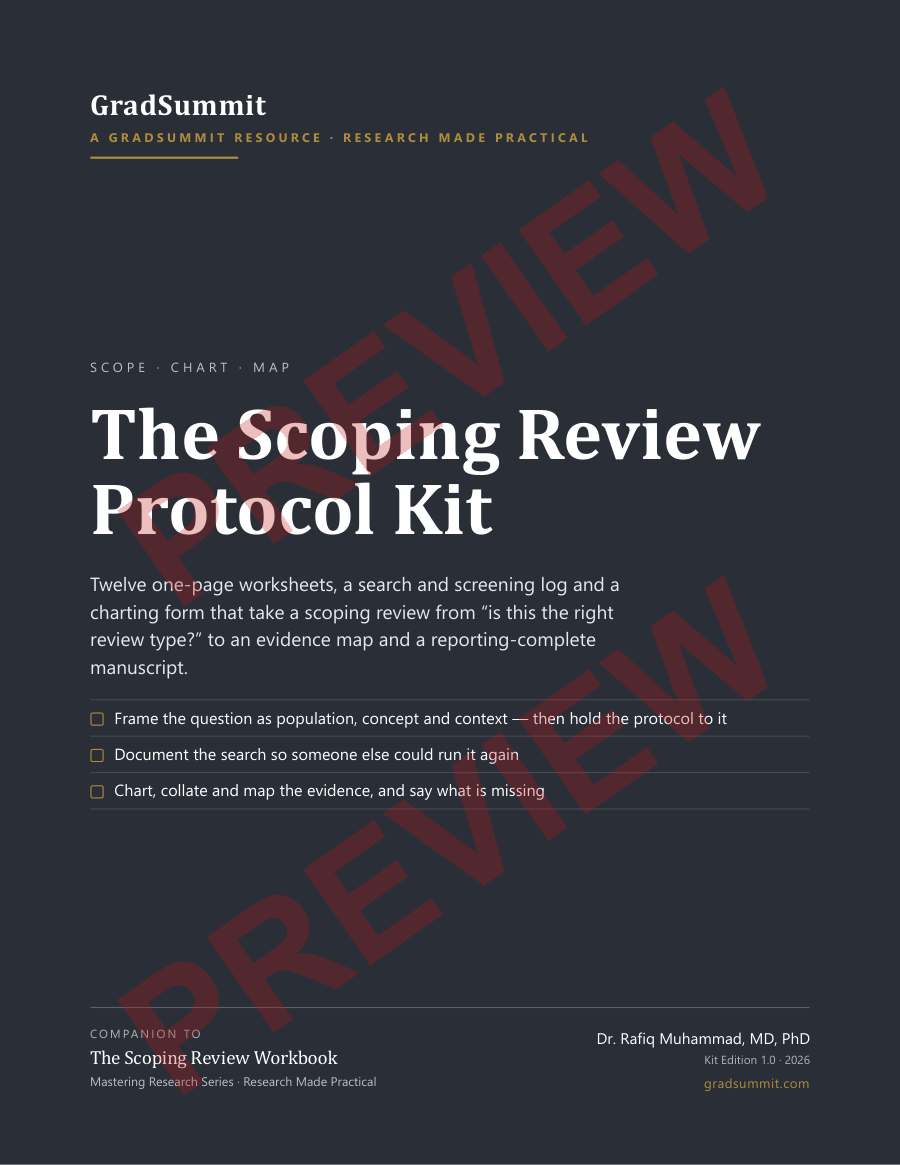 Literature review chapter
The Scoping Review Protocol Kit
A protocol, search log, screening record and charting form for a thesis scoping review - so the chapter can be examined and the review published.
$12 -
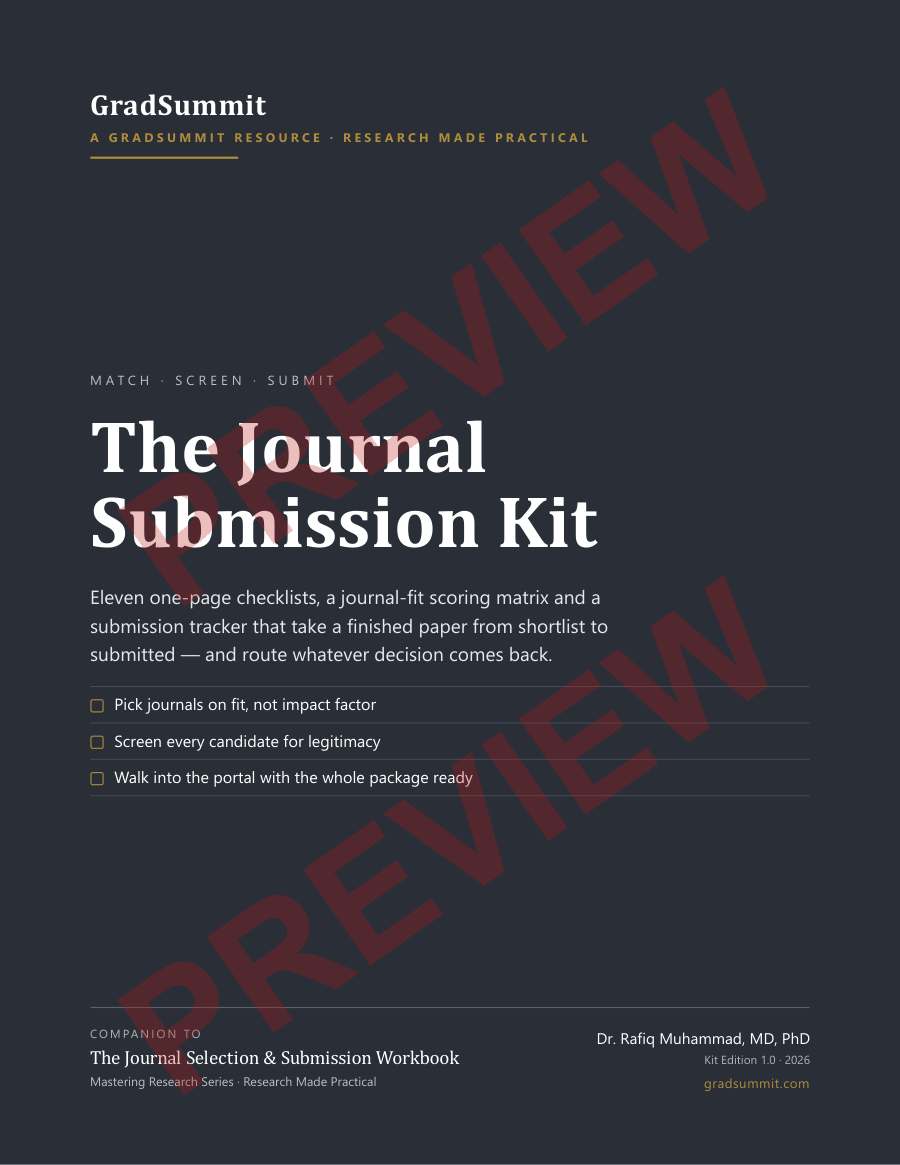 Publishing during candidature
The Journal Submission Kit
Checklists and a tracker for submitting a paper during your PhD: shortlist journals, check scope and legitimacy, build the package and track decisions.
$9 -
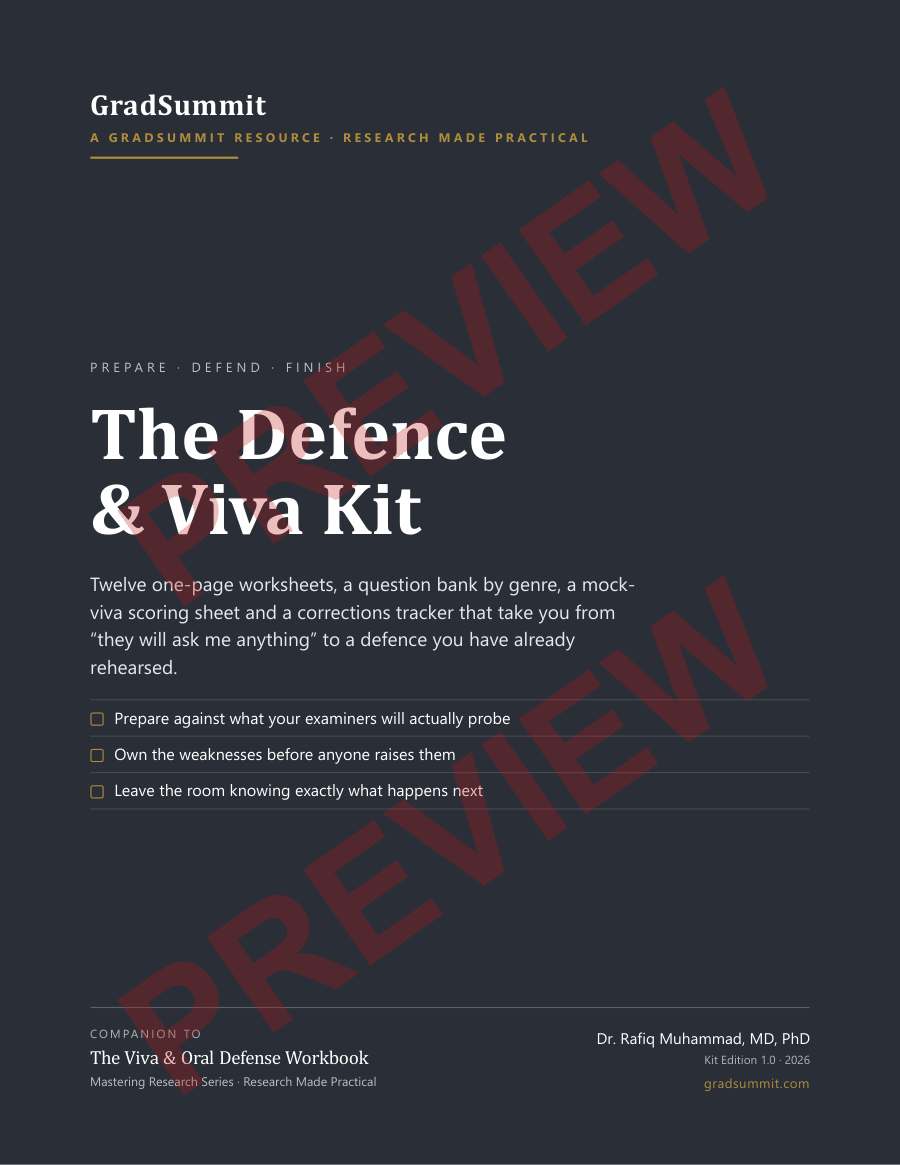 Examination
The Defence & Viva Kit
Prepare for your viva or thesis defence: a question bank by type, examiner dossiers, mock-viva scoring and a corrections tracker for after.
$15
Frequently asked questions
Should I tell my supervisor I use AI tools?
The kit assumes yes, and gives you a record to share: what you used, for which tasks, and how you checked the output. Most supervision problems start with finding out late.
Does my thesis need an AI declaration?
That depends on your institution and, for papers, on the journal. The policy register captures each rule in its own words so you answer the declaration from evidence, not memory.
Can I use AI on interview transcripts or participant data?
Often not without explicit ethics approval. The data gate is there to decide that before it happens, against your approval and consent forms.
Is this against using AI?
No. It takes careful use as the starting point and helps you document it well enough to stand behind.
What do I get, and in what format?
One ZIP download: the kit as PDF in both US Letter and A4, and a workbook that opens in Excel or Google Sheets. Fill the PDFs in on screen or print them.
How do I get the files?
The download page opens as soon as Stripe confirms payment, and a copy of the link arrives by email. A link stays valid for two weeks and ten downloads, and a replacement can be requested below whenever you need one.
Who processes the payment?
Stripe. The receipt and download email come from the author's publishing imprint, GradSummit, which delivers the kits for this site. Your card details are never seen by us.
What if the files will not open?
Email us within two weeks of buying and we will fix it or refund you in full. A refunded purchase can no longer be downloaded.
Lost your download link?
Type the address you paid with and a new link will be sent to it.